Low-Pass Filter:
Potentiometer Value: 10,000 Ohms
Corner Frequency= 1/(2pi X R X C)
20 Hz.= 1/(2pi X 10,0000 Ohms X C) X (C/1)
(1/20 Hz.) X 20 Hz. X C= 1/(2pi X 10,000 Ohms) X (1/20 Hz.)
C= 1/(2pi X 10,000 Ohms X 20 Hz.)
C= 1/(1256637.06144)
C= 0.00000079577 Farads
C= 0.79577 uF
From here, I rounded up and decided to use a 1 uF capacitor.
Photo of Circuit:
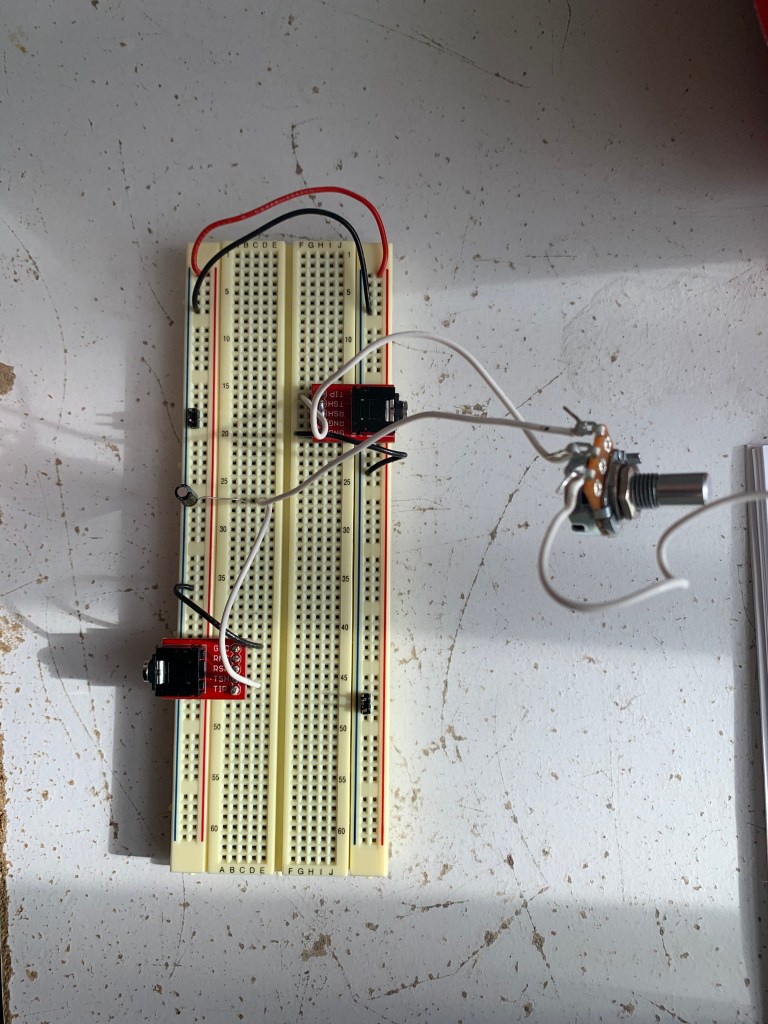
High-Pass Filter:
Potentiometer Value: 100,000 Ohms
Corner Frequency= 1/(2pi X R X C)
20,000 Hz.= 1/(2pi X 10 Ohms X C)
20,000 Hz. X C = 1/(2pi X 10 Ohms X C) X (C/1)
(1/20,000 Hz.) X 20,000 Hz. X C= 1/(2pi X 10 Ohms) X (1/20,000 Hz.)
C= 1/(2pi X 10 Ohms X 20,000 Hz.)
C= 1/(1256637.06144)
C= 7.95774715e-7 Farads
C= 0.000000795774715 Farads
C= 0.795774715 uF
From here, I rounded up and decided to use a 0.1 uF capacitor
Photo of Circuit:
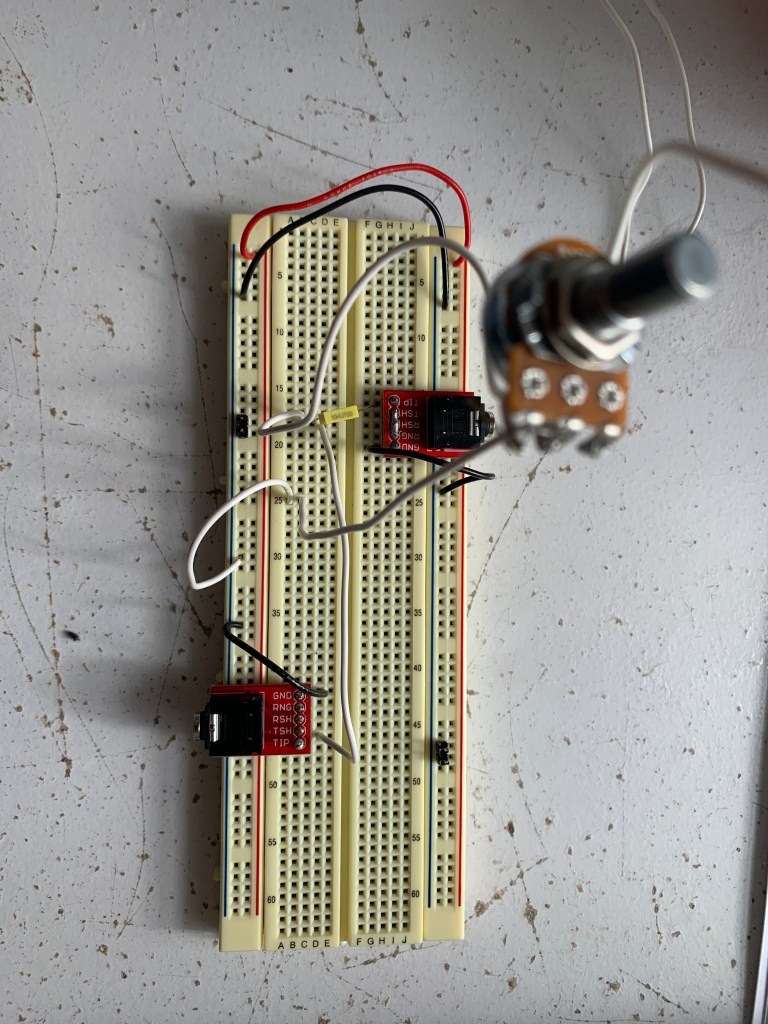
Schematic:

Answer This Question:
I think that you create a 12dB/octave filter by doubling the value of the cutoff frequency in the equation, and solving for the values of resistance and capacitance that you need to create this filter. Since we are making a -6dB filter using the cutoff frequency, I think it would make sense to double this frequency in order to create a -12dB filter. For the -18dB filter or -24dB/octave filter, I would triple or quadruple this value of the cutoff frequency, respectively. This would yield increasing amounts of resistance values for the potentiometer or capacitor, which would allow us to achieve these effects (?)
Final Project:
- Describe in a few sentences a Final Project you think you could build, which would be interesting to you, which appears to be at about the skill level of the analog students from last year.
I would be interested in trying to guitar pedal with distortion, low pass or high pass filters or other effects. I saw that a few people completed this project in previous years, and I thought their project came out really cool, and I liked the amount of control they had over the tone of the guitar. I really love to play the guitar, and I think working on building a guitar pedal would be a cool way to learn more about the way they work and how effect pedals work. - Describe in a few sentences something you could build which you think might be slightly more difficult than that, but maybe possible, which would make a compelling Final Project for you.
I do not have good judgement on what would be a difficult project and what wouldn’t be, but I would also be interested in making a square wave synthesizer, with each note tuned to one of the notes of the pentatonic scale, that would make improvising easier than a regular major or minor scale. Additionally, making each key trigger a chord in a major or minor key would be really cool, but I think it might be too ambitious. Overall, though, I think tuning each note to the pentatonic scale would be a cool and (maybe) different take on the synthesizer project. - Describe in a few sentences any type of professional, sold-in-stores analog audio electronics which you find compelling and wish you could understand, design, and build.
I am really intrigued by experimental guitar pedals with strange effects. Beyond just regular distortion pedals or loop pedals, there are also pedals dedicated to providing the guitar with really unusual sounds, like synthesizer sounds, emulate a simple square wave or more complex synth. I’ve even seen a pedal intended to imitate the sound of a flock of birds. I’ve always wanted to know and understand the electronics of the pedal, and how they are able to produce these weird effects using a complex combination of familiar effects. Also, I’ve never tried one of these guitar pedals, so it would be interesting for me to make my own unique pedal, and be able to use it.
 Sarah's Analog Electronics Lab Reports